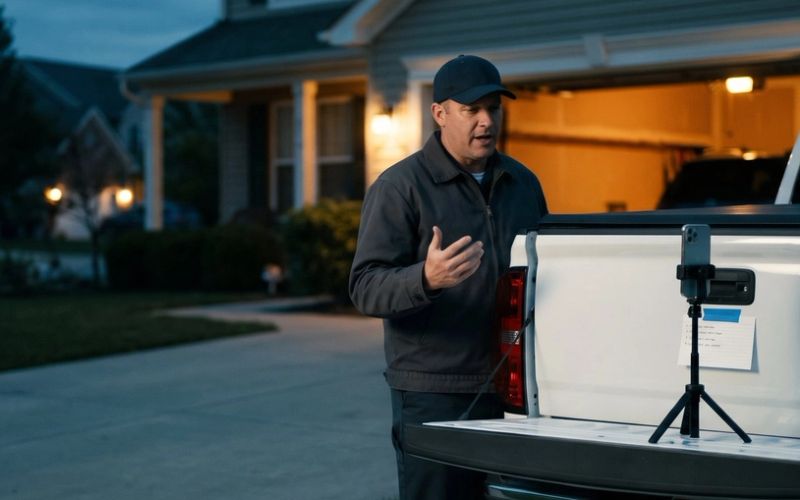

A landscaping company finishes a backyard in May. Pavers, a fire pit, new sod, lights strung over the patio. A week later the homeowner texts the owner a forty-second phone video: a slow walk across the yard at dusk, and a voice saying "I honestly didn't think it could look like this."
The owner writes back "Can we use this?" The homeowner writes back "Of course!"
That clip becomes the best ad the company has ever run. It goes into Meta in June, gets trimmed into three cuts, and is still spending in January. It has paid for itself many times over.
And at no point did anybody sign anything.
This is the most common setup in small business creative, and it is common for a good reason. A real customer saying a true thing on a phone is the most persuasive asset you can put in front of a stranger, which is exactly why we wrote a whole piece on finding those testimonials. That piece ends with a single line of advice: get permission to use the footage in paid ads up front. This article is about what that line actually means, because "Of course!" in a text thread is not it.
One ad can carry three different owners at once. The person who filmed it owns the footage. The person on screen controls their own face and voice. Whoever wrote the song owns the song. You need a yes from each of them, and the more money you put behind the ad, the more it matters that you can prove it.
Whoever Pressed Record Owns the Video
Start with the footage itself, because this is the one most owners get backwards.
Under US copyright law, the person who creates a work owns it from the moment it exists. A video is created by whoever was holding the camera and making the choices: where to stand, when to start, what to point at. That is the homeowner in the backyard. It does not matter that the yard is your work, that the video is about your company, or that you asked them to film it. They pressed record, so the clip is theirs.
There is one big exception, and it works in your favor. Footage an employee shoots as part of their job is a "work made for hire," and it belongs to the employer. When your crew lead films a finished job on a company phone during the workday, that clip is yours.
The exception has edges worth knowing:
- A freelance videographer is not an employee. If you hire someone to shoot your ads, they usually own the footage unless your agreement says otherwise. Most professionals will happily sign the rights over or license them broadly. They just need to be asked, in writing, before the shoot.
- An employee's personal video is not a work for hire. A technician filming a clip on their own phone on a Saturday because they were proud of the job is closer to the homeowner than to the crew lead.
- A customer is never an employee. No matter how much you love them.
None of this means the homeowner is going to come after you. Most never would. It means that the single most valuable asset in your account is sitting on a permission you could not describe precisely if you had to, and that is a strange place to keep something you are spending real money behind.
A Text That Says "Sure, Use It" Doesn't Hand You the Video
Here is the part that catches people. Federal law says a transfer of copyright ownership is not valid unless it is in writing and signed by the owner. A text thread is not a transfer.
What a friendly "Of course!" probably gives you is a permission: a loose, unwritten license to use the clip. The trouble is that a license is only as wide as what both sides understood at the time, and nobody in that text exchange talked about any of the things that end up mattering:
- Paid ads or just a post? "Can we use this?" sounds, to most customers, like "Can we put this on our Facebook page?" It never sounds like "Can we spend $2,000 a month showing this to strangers for the next eight months?"
- Edited or as-is? You cut it into three versions, added captions, put your logo on the end and dropped a song under it. Nobody agreed to that.
- For how long? A permission with no end date is easy to imagine as forever and easy for the other person to imagine as "for a bit."
- Can they take it back? An unwritten permission can be very hard to hold onto once the customer changes their mind.
And customers do change their minds, almost never out of malice. They move. They sell the house. They get divorced and do not want their old patio and their old life running in their neighbors' feeds. Their new employer has a policy about appearing in advertising. When that call comes, an owner with a signed release has a conversation. An owner with a text thread has to pull the ad.
You Can Own the Video and Still Not Own the Customer's Face
Suppose you fix the footage problem. Your own employee filmed the job, so the clip is unambiguously yours. You can still be using something you do not own: the person in it.
Many states give people some control over the commercial use of their own identity, usually called the right of publicity. It is a separate right from copyright, and it attaches to the person on screen, not to whoever filmed them.
California's version is a good illustration of why it is worth taking seriously. Its civil code makes anyone who knowingly uses another person's name, voice, photograph or likeness for advertising without their prior consent liable for the greater of $750 or the actual damages, plus any profits from the use, with punitive damages and attorney's fees also on the table. For a minor, the consent has to come from a parent or legal guardian.
That turns three ordinary situations into real exposure:
- The employee who quits. Your best technician stars in your best ad. Eighteen months later they leave on bad terms and work for a competitor. Their face is still selling your services. Whether you can keep running it depends on what they agreed to, and "they were on the clock when we filmed it" answers the footage question, not the face question.
- The kids in the background. The homeowner's video includes their children running across the new lawn. The homeowner can speak for their own kids, but only if somebody actually asked.
- The bystander. A neighbor waves from across the fence, clearly recognizable, in a clip that is now an ad. Crop them out, blur them, or get them on paper.
A good release covers footage and likeness together, in one signature, which is exactly why it is worth having one.
A UGC Creator Sold You 30 Days of Ads, Not a Video
Hiring a creator to make content for you feels like buying a video. In most creator deals, it is closer to renting one.
The industry standard is to price the making of the video and the right to run it as a paid ad separately. The base fee covers the creator's time and the footage. Using it organically on your own page is often cheap or included. Putting ad spend behind it is a separate, time-limited right, and running it from the creator's own account ("whitelisting," which is how partnership-style ads work) is another add-on on top of that.
UGC Bloom's 2026 pricing guide puts the published bands at roughly:
- 20-30% of the base fee for 30 days of paid social use
- 30-45% for 90 days
- 70-100% for 12 months
- 25-35% per 30 days to run it from the creator's handle
- 150-300% for a perpetual buyout across all channels
On a $400 video, 90 days of paid use adds something like $120 to $180. That is not where the money goes wrong. The same guide names the expensive mistake plainly: a 30-day license attached to an ad set that nobody paused. The video is still spending in month four. The license ended in month one. You are now running an ad you do not have the right to run, and creators do notice when their own face keeps showing up in their friends' feeds.
Two habits fix almost all of this:
- Buy the window you will actually use, and put the renewal price in the first contract. Most ad creative tires out within weeks, so a 30- or 60-day window is usually right. But the moment a video starts winning, its price goes up, because now the creator knows what it is worth. A renewal rate agreed before anyone knew the ad would work is the cheapest version of that number you will ever see.
- Put the expiry date somewhere you will see it. A note in the ad name ("UGC-Maria-exp-Mar14") costs nothing and turns an accidental violation into a calendar decision.
A Partnership Ad Stops the Day the Creator Says So
Partnership ads, where your ad runs from a creator's or customer's own Instagram or Facebook account, often outperform the same video run from your page. People trust a person more than a logo, and the format leans into that.
They also come with a switch you do not control. Meta's own help center says it plainly: creators and other partners can revoke partnership ad permissions at any time.
That is fair. It is their name on the post. But it means your best-performing ad can go dark in the middle of a month for reasons that have nothing to do with you: the creator signs with a competitor, cleans up their account, or simply decides they are done. No warning is required.
The practical answer is not to avoid partnership ads. It is to never let one be the only thing holding up your results. For any partnership ad doing heavy lifting, have a version you own outright, run from your own page, ready to take over the budget the day the permission disappears. If you are thinking about how many ready-to-go ads an account should keep in reserve, we covered the bench and who makes it in more depth.
The Radio Playing in the Customer's Video Is Someone Else's Song
If any one piece of an ad gets it taken down, it is usually the music. We covered the basic rules in our piece on sound in video ads: the popular-song library inside Facebook and Instagram is for personal use, and Meta's Sound Collection is the safe one for ads. That is the music you choose. The music that catches owners off guard is the music they never noticed they had.
Customer and creator footage is full of it:
- The radio in the background. The homeowner filmed their walk-through with a speaker playing on the patio. That song is now under your ad, and it belongs to a publisher and a label, not to the homeowner and not to you. The homeowner's signature on your release cannot license a song they never owned.
- The trending audio. A creator delivers a clip cut to a sound that is popular on Reels this month. It looks native, which is the point, but a sound that is fine in a personal post is not automatically cleared for paid advertising.
- The TV in the corner. A game on the screen behind your customer is somebody's broadcast, logos and all.
Meta's ad standards say ads may be rejected or removed after being reported by an intellectual property rights holder. And because a song runs under every second of a clip, you cannot trim your way out of it. When you get customer footage with music already baked in, strip the audio and keep the customer's voice if you can, or ask them for a take without it. Most phones record the voice clearly enough that a quieter second take is a two-minute favor.
The same caution applies to anything you did not make yourself. Stock sites label some photos and clips "Editorial Use Only," and on Shutterstock that label means the asset is not cleared for commercial use, usually because nobody has a release from the people or property in the shot. Those are for news and commentary, not for selling your business. Filter for commercial licenses before you download, not after the ad is live. And an image you found on someone else's website or in a Google image search is not stock at all. It is somebody's work with no license attached.
A Real Customer Can Still Make Your Testimonial Ad Illegal
Everything so far is about who owns what. There is one more layer, and it applies even when every signature is in place. The Federal Trade Commission treats a testimonial in an ad as your advertising claim, not just the customer's opinion, and it has rules for it.
Three of them come up constantly for small businesses:
- If you gave them something, the ad has to say so. A discount on the next service, a free month, a gift card, a product to keep: under the FTC's Endorsement Guides, that is a "material connection," and viewers are entitled to know about it. The FTC wants the disclosure to be hard to miss, on screen and ideally spoken, not buried in the caption.
- It has to match what actually happened. A testimonial has to reflect the customer's real experience. You can trim a clip for length. You cannot cut it so that it says something they did not mean, or stitch two customers into one result.
- Old testimonials expire too. If the ad implies the customer still uses or still recommends you, the FTC expects you to have good reason to believe that is still true. If your service, pricing or product has changed since they filmed it, the FTC's own guidance is that it is best to get new endorsements.
A formal FTC rule on consumer reviews and testimonials also took effect in October 2024, and it lets courts impose civil penalties for knowing violations. It does not ban paying for honest feedback. It bans making the reward depend on the feedback being positive, including by implication. The FTC's own example of a violation is an offer that reads "Tell us how much you loved your visit to John's Steakhouse and get a $5 coupon." If your testimonial request sounds like that, rewrite it before you send it.
And if the person in your testimonial ad was generated by a tool rather than filmed in a backyard, that is a different problem with a stricter line, which we covered in our piece on AI people in ads.
A One-Page Release Costs Less Than Pulling Your Best Ad
None of this takes a lawyer on retainer. It takes one page, signed before you put money behind a clip, and a list you actually keep.
A workable video release form for a small business covers seven things:
- Who filmed it, and a line transferring or licensing the footage to your business.
- Who appears in it, with consent to use their name, face and voice. A parent or guardian signs for anyone under 18.
- Where it can run: your website, social pages, and paid ads on named platforms. Say "paid advertising" in those words.
- What you can change: trimming, captions, music, your logo, cutting it into versions.
- How long: a fixed term, or until they ask you to stop with a stated notice period, such as 30 days.
- What they got in return, even if the answer is "nothing," so the disclosure question is settled in writing.
- A signature and a date, which can be electronic. A form link sent the same day they send the video works fine.
Then keep a simple rights log, one row per live ad: the asset, who is in it, what paperwork you have, and the date it expires. Check it once a month when you look at your results. An ad whose row is empty or past its date comes out of rotation until the row is fixed.
The best time to ask is the moment the video arrives, while the customer is happy and the favor is fresh. "This is amazing. Would you be okay with us using it in our ads? Here's a quick form so it's all official" is an easy yes on day one. Eight months later, with the ad already a success, it is a much more awkward conversation.
This is general information about how ad rights usually work, not legal advice. If a release is protecting something that matters a lot to your business, an hour with an attorney to turn this checklist into your own form is money well spent.
When we produce creative for the businesses we work with through our creative production service, the paperwork ships with the ad, so the best thing in the account is also something you can keep running. And if you would rather handle it yourself, the seven lines above are the whole job.